Don’t Race Your Younger Self: Running Slower as You Age

older runner training and staying motivated despite running slower with age

It’s a simple fact of life: as we get older, we get slower.

How much slower, and how fast that happens, depends on a lot of factors. Training history, genetics, injuries, consistency, and overall health all play a role. But the general pattern is well established: performance typically begins to decline sometime in our 40s, and that decline tends to accelerate as we move through our 60s and beyond.

There’s no magic switch to stop it completely. But, as I’ve said elsewhere on this blog, there is a lot we can do to push back, slow the rate of decline, and keep the quality of our running high for many years.

Where many older runners get into trouble, though, is in how they frame that reality.

The Problem With Comparing Yourself to Your Younger Self

Wistfully comparing your current performance to what you could do 20, 30, or even 40 years ago can be a real motivation killer.

It’s frustrating.
It can drain the joy out of training and racing.
And most importantly, it’s simply not fair to yourself.

You’re not the same runner you were decades ago — and that’s not a failure. It’s biology.

Of course, this comparison trap assumes that you were running back in your younger days and have faster times burned into your memory. If that’s not your history — if you’re actually working harder at fitness now, after 60, than you ever did before — then you’re in a different and very positive situation.

If you’re getting stronger, fitter, or faster now than you were five or ten years ago?
That’s a win. Go you. Seriously, congratulations.

The Temptation to “Race” Your Younger Self

For runners who do have those old PRs rattling around in their heads, there’s a natural temptation to chase them.

And to be fair, that comparison can sometimes be motivating. It can encourage consistency, discipline, and effort.

But it’s a slippery slope.

Too often, it turns into obsessing over the gap between then and now.
It becomes a constant reminder of what’s been lost instead of what’s still possible.
And eventually, that frustration can crowd out the simple joy of running.

Why Those Comparisons Aren’t Fair Anyway

When you really think about it, comparing your current self to your younger self ignores a mountain of differences:

  • Recovery is different
  • Hormones are different
  • Injury history is different
  • Life stress is different
  • Time availability is different

You’re not lining up on a level playing field, and pretending otherwise only sets you up for disappointment.

Even worse, those comparisons can quietly steal the satisfaction of showing up, training smart, and doing hard things at an age when many people have already given up on fitness altogether.

A Better Way to Think Measure Performance After 60

Instead of racing your younger self, try reframing the game entirely.

Here are some healthier, and far more motivating, alternatives:

  • Reset your expectations and embrace where you are right now.
    This is a new chapter, not an epilogue.
  • Race your age group.
    Let’s be honest — an age-group win or podium spot is always fun.
  • Give yourself permission to be older and slower.
    This is not quitting. It’s reality — and it’s okay.
  • Start over with new PRs after 60.
    Your “after-60 PRs” deserve just as much respect.
  • Compare age-graded performance instead of raw times.
    This one is a game changer.

Why Age Grading Makes Sense for Older Runners

Age grading allows you to compare effort relative to potential, rather than comparing raw times across decades.

An age-graded percentage tells you how close your performance is to the statistical best for someone your age and gender at a given distance.

That means:

  • You’re rating performance in context
  • You can compare potential across age groups
  • A slower net time today might actually represent a higher performance level than a faster time from years ago

That can be genuinely surprising — and incredibly motivating.

Age grading becomes a way to gauge your current fitness against what’s realistically possible, not against a version of yourself who lived in a different body, at a different time.

Other Useful Benefits of Age Grading

Beyond motivation, age grading can actually help guide your training:

  • Compare your performance over time as you age
  • Compare runners of different ages, genders, and distances fairly
  • Identify which race distances suit your strengths best
  • See where your training might need more focus

In short, it helps you work with your age instead of constantly fighting it.

Letting Go — and Moving Forward

Letting go of the capabilities of your younger self isn’t easy. Those memories are powerful, and they’re tied to pride, identity, and years of hard work.

But this stage of life offers something valuable in return.

You can start fresh.
You can find real joy in staying strong and active as an older athlete — because you are an athlete.
You can embrace the challenge of consistency, smart training, and showing up for yourself.

And you can stay motivated by measuring success in ways that actually make sense now.

Don’t race your younger self.
Race the version of you that keeps going.


If you liked this post, please let us know by leaving a comment below and consider supporting the site.
More About Age Grading

Age Grading Calculators

https://runbundle.com/tools/age-grading-calculator

I Decided To Start Competing in Track — At 61!

What was I thinking?

A few years ago, as a “Grand Master” runner, I decided to redirect my athletic and fitness goals. The big shift has been focusing on the shorter races and pulling back from the glamour goal of the marathon. After my experiences running Boston in 2022 and 2023 (short version: I crashed in 2022, falling well short of expectation, and DNF’d in 2023), it would be understandable if people said, “Oh, Greg couldn’t take the heat,” or, “Too much for you, so you’re quitting.”

But it’s not that at all.

I started thinking about the realities of my aging body. You know, all the scary stuff: loss of muscle mass, fine motor control, explosive power, flexibility, suppleness, elasticity, and balance (National Library of Medicine link) piled on top of the usual stuff like vision, hearing, memory, brain function, etc. Lots to look forward to, lol!

I grudgingly accepted that the eventual loss is inevitable (it’s called dying). But what about the time between today and then?


First, The Problem

OK, the bad news:

Peak physical strength generally occurs between the ages of 20 and 35, with specific peaks varying between individuals and sexes, and often occurring around age 25 for general muscle strength. For most people, muscle mass and strength peak in the late 20s or early 30s. After this period, strength begins a gradual decline (Harvard Health link).

The best way to address all of that is to engage in activities directed at improving those functions. Simple stuff such as strength training and yoga can work wonders — and I was already doing that.

Now, I’m the sort of person who needs a goal to help with motivation. You too? Sure, being healthy and active into my 70s, 80s, and (hopefully) beyond is an excellent goal and certainly plenty. But I knew I needed something more focused and near-term that I could work on — something that also provided the training that would address the problems.

Yes, I realize that I can strength train, do yoga, run speed workouts, and all the rest and train for the marathon and set goals for those races — and it would do nicely for addressing the above issues. However, the training blocks are long, and the goal races can only be so frequent (one or two per year). Also, more personally, I have not been doing that sort of running and training for decades like many people. My running from my 40s to my late 50s has been 4–6 miles at a time, three or four times a week, with occasional speed work.

Of course, there was the roughly two-and-a-half-year attempt at getting a BQ (Boston Qualifying time) and then running the Boston Marathon — that’s another story entirely.

In short, I was looking for more intensity, less training time, and more frequent high-energy competition.

Looking For Options

I started to rethink what I was focusing on with my running, which is the major activity of choice for me and the one that offers the additional aspect of regular competition. “Shorter races,” I thought. 5K, 10K, and the occasional half. The beauty is that there are events of those distances almost every weekend, wherever you go. Plus, with the 5K and 10K you can easily race every few weeks.

On top of that, the training to improve in the 5K utilizes more strength and power and higher intensity than the long distances. Hello short intervals, shorter long runs, and a bit less of the really long sustained efforts.

Redirecting like that made me get more serious about being regular with the weights and the yoga, since they supported both the near- and long-term goals.

Excellent!

Then, I found out about the Senior Games.

From their website:

“Promoting the benefits of competitive sports, physical fitness and active aging to adults ages 50+.

Welcome to the Senior Games! Our Olympic-style multi-sport events held at the local, state and national level across the United States engage over 100,000 participants ages 50+ each year.

Senior Games provide the camaraderie and challenge of competitive sports to older adults, promote health and well-being, and inspire participants to keep moving.”

Who knew there was any way to compete like this post-college unless you were an elite? Never mind once you’ve reached 50, 60, or older?

Training for the track and the shorter, faster races such as the 5K requires working on the very qualities that I am interested in improving (before I meet the decline coming in the opposite direction).

Hitting The Track

Since I made that decision, I have competed in eight track meets, including the Florida State Senior Games, trying my legs at the 100m, 200m, 400m, 800m, and 1500m events. I found out pretty quickly that the 100 and 200 might not be my events, lol, but every event and every meet has been a chance to challenge myself. Plus, they have been opportunities to be impressed and inspired by the performance of runners much older than I am.

Seeing men and women in their 80s and 90s with spikes on, running a brisk 100m sprint, cruising a 400m, or grinding out a 1500 is NOT what we see every day in life. But there they were, on the track, demonstrating what aging gracefully and vigorously looks like.

So yes, the decision to include track workouts and competition has been a challenge, has made me a stronger (and healthier) runner, and has also shown me the level of performance that is possible for all of us as we get older.

Pushing back the clock, indeed!


If you liked this post, please let us know by leaving a comment below and consider supporting the site.
In Praise of Age-Group Awards

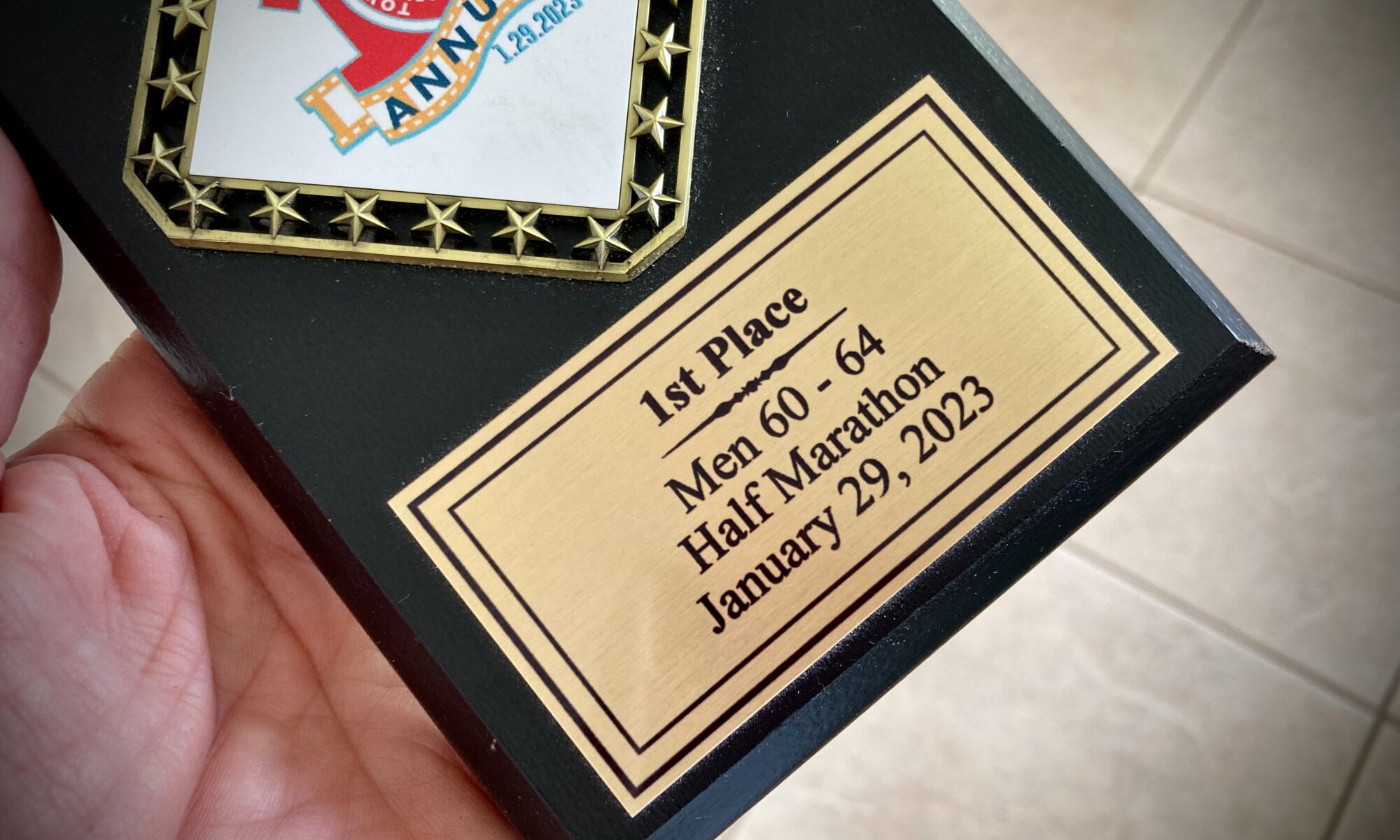
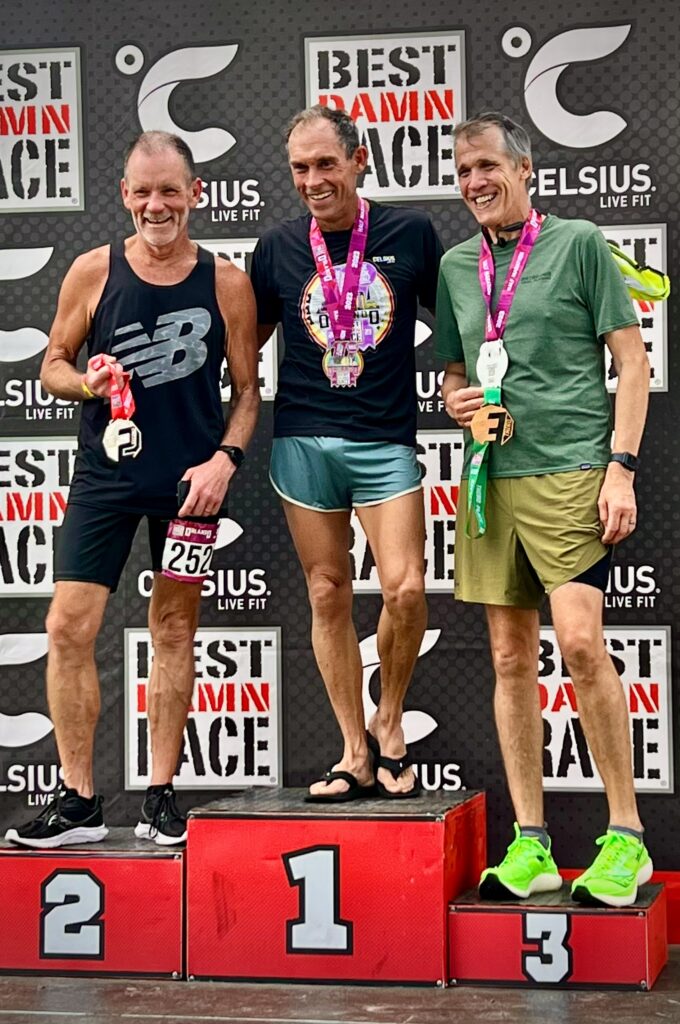
The author's half marathon age group award

Some people think they are a little silly, but I’m a fan.

I know there is a trend lately of “everyone is a winner,” and plenty of people get all grumpy about it, complaining that it devalues actual winners (generally top three male and female), and that one doesn’t need recognition for simply participating.

But, honestly, what’s so awful about a little “way to gofor showing up at a race? Or some official call-out for doing well compared to your age peers?

Sure, there are, usually, only two people who win a road race and six who place (top three for men and women). Recognizing only those individuals is the way to go at an elite event where all participants are within a narrow performance spectrum, but I’m talking about events for regular folk.

You know, the 5K races you can find almost anywhere, all year round, with everyone from first-timers, walkers, couch-to-5K, high school cross-country speedsters, elementary school kids, seniors working hard to hold off age decline, and parents with headphones and strollers.

Those races.

After all, actually winning, or even placing, in a race is unquestionably the province of the young, and by “young” I’m talking teens to late 30s. Once we age past 50, even the fittest of us have the slimmest of hopes to challenge for a win, no matter the event.

Competition is Good

Age group awards are fun. They encourage friendly competition with people of your own age, and some bragging rights when you beat those in a lower age group. It’s great stuff.

Plus, that friendly (but determined) competition and bragging rights are excellent motivators to keep at it and keep going with your fitness. And we all benefit from having motivators and fitness goals.

The author at a recent race with the other 60–64 guys (no, I didn’t run in sandals)

For many of us, fitness is a challenge as we age. It may be that you let it slide a bit (or a lot) while you were in the career/family-raising stage of life, and you’re trying to get on top of it. That is an all-too-common scenario to find oneself in somewhere between 50 and 60.

It’s hard to get going and to keep going, so motivation is hugely valuable. The friendly competition with your five-year age-group peers can be just the right push!

Yes, The Awards Take Time

I realize that the post-race announcements, medal presentation, and winners’ photos for every. single. age. group can feel a bit tedious for some.

Even though I am fortunate to commonly place in my age group, and enjoy the “atta boy”, the additional medal (usually), and getting a photo with the others, I’ve felt that myself.

It’s the waiting.

I mean, since almost all events start announcing the awards with the youngest, there are a LOT of people ahead of you when you reach 60+ years of age.

A Small Suggestion for Race Directors

I applaud all Race Directors—no matter the size of the event. Being RD is a tough job! But, here’s a thought: how about we switch the order in which age group awards are presented at the end of the race? Of course, the young people are running and doing well; let’s celebrate the old folk who are out there, making it happen and getting it done.

Plus, as adults, parents, and grandparents, we spend a lot of time waiting for the kids. It’s OK for them to wait a little bit while we get our recognition.

A bit of turnabout is fair play, no?

I’m all in on the age-group award fun and celebrating everyone showing up and doing their best. How about you?


If you liked this post, please let us know by leaving a comment below and consider supporting the site.
Getting From the Start to the Finish Line Makes You Special. Go You!

It’s like cake! Let me explain…


I’ve been a runner for decades.

In those decades, I have participated in races of all kinds and distances—giant events to local fun runs. At those races have been real runners of ALL ability levels, and I get excited that people have shown up and are ready to go for it.

Like many of us, I have had times when I have trained for specific events and periods when I’m just trying to keep moving regularly. I’ve also spent time as a Certified Personal Trainer and coaching friends with their running. So, I have had many opportunities to encourage beginners and other runners who feel intimidated or discouraged about their abilities compared to “real runners.”

The Conversation

Here is a conversation I have had many times with other runners, particularly recreational runners or new runners, but also long-time participants.

It goes something like this:

me: “Hey, good to see you here at the race! You ready to go?”

them: “Hi! Well, I’m okay, but I’m not as fast as most of these people…”

me: “That’s no big deal, everyone is at a different stage in their fitness and experience. You got here — you do your thing.”

them: “I haven’t done too many races, so…I’ll probably need to walk a little.”

me: “and that’s perfectly fine. After all, you’ll still be beating every single person who couldn’t get off the couch this morning!”

So What’s The Cake Part?

The point I want to make to people when we have this conversation is that they are already way ahead of lots of others and are actually pretty special.

That’s when I say that it’s like cake.

Imagine a nice frosted layer cake representing the entire population. Everybody.

Continuing with the metaphor, the frosting on the top is everyone who does some running or jogging (15% of the US population).

Any distance at all. Any speed.

Then, the very top part of the frosting (the part with the sprinkles or the decorative ganache) are people who enter and run in a road race. Everyone from Faith Kipyegon and Eliud Kipchoge to your 85-year-old grandma who walks a 5K in an hour and a half.

Everyone.


According to this IAAF report, about 0.1% of the US population races. The world’s highest is Ireland at 0.5%

Also, worldwide, about 1/3 of the population aged 15 and over doesn’t get enough basic exercise, and this study identifies many troubling consequences.


Showing Up Makes You Special

Even though there are a few thousand runners at many events, they are still this teeny tiny percentage of the general population.

Therefore, simply showing up and running the race puts you in the highest percentile of not only the population, but also active runners.

So, “yay us!” I say.

Keep moving, keep running, and I’ll see you at the next race. Let’s all be frosting together.


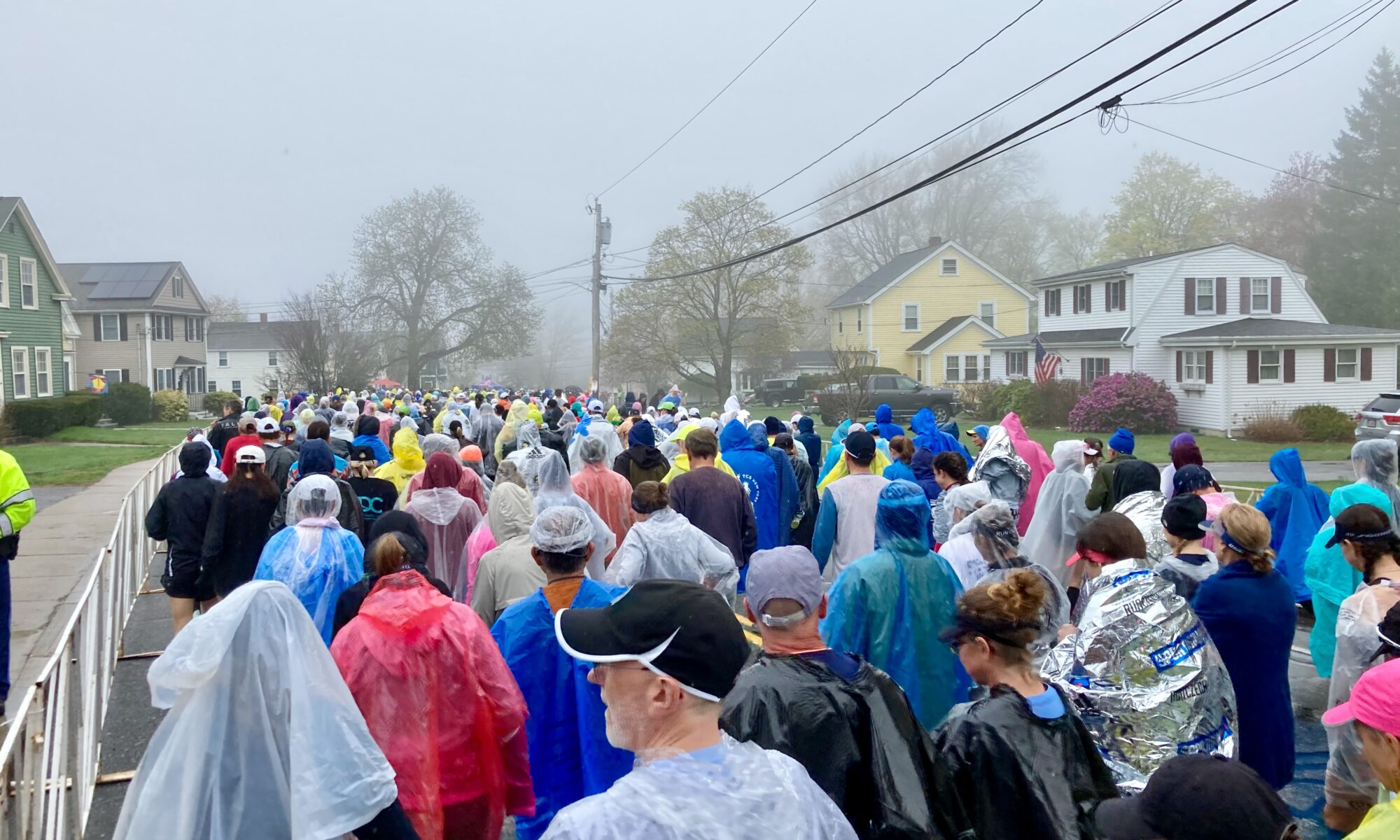
photo: The start corral crowd of runners at the 2023 Boston Marathon (by the author)

If you liked this post, please let us know by leaving a comment below and consider supporting the site.
You’re Never Too Old to Be a Real Runner

Running is something natural, right?

You did it as a kid without thinking. You just took off across the yard, chased your friends, ran for the sheer joy of it. It was effortless—and honestly, it was pretty fun.

Then life happened. Work, family, responsibilities, decades of being “busy.” Maybe a few aches showed up. Maybe the idea of exercise became something serious instead of something joyful. But eventually you decide: I’m going to start running again. And it seems simple, right? Lace up, head out the door, take off down the street or onto a trail.

Is This Real?

Except… maybe now it’s a little slower. Maybe you’re not exactly gliding. Maybe you need to—gasp—alternate walking with running. And then some other runner comes cruising by, smooth and fast, and you think, “Now that’s a real runner. That’s what I’m working toward.”

Sometimes that’s motivating. Sometimes, for newer or older runners, it’s discouraging: I’m never going to run like that again. Or maybe you’re mid–walking break and feel a little embarrassed.

Going For It

But you keep at it. You get stronger. You take fewer walk breaks. You start noticing the fancy shoes with the giant foam stacks and the watches that look like mission control. You hear people talk about marathons, BQs, age-group records, and those Abbott World Marathon Majors stars.

And then somebody convinces you to join Strava, where normal-looking humans are apparently out there running 40-mile weeks and crushing monster workouts before breakfast.

Here’s the truth: you don’t need any of that. That isn’t what defines you as a “runner.”

Not the races, not the watches, not the super shoes, not the selfies, not the social media uploads, not the mile splits, not the comparison game. You don’t even need to run the whole time.

At our age, (and, really, any age) the magic is wonderfully simple. There’s only one thing you need to do to be a real runner:

Get on your feet and start running.

Your pace doesn’t matter. Your walk breaks don’t matter. Your age absolutely doesn’t matter. If you’re out there moving forward—consistently, joyfully, at whatever speed works for your body—you’re already a real runner.

Oh, and don’t forget the most important part:

Have fun doing it!


If you liked this post, please let us know by leaving a comment below and consider supporting the site.
How To Get Started Running After 60 (Even If You’ve Never Run Before)

If you haven’t been running in a while, or just for the first time.

Starting to run after 60 can feel intimidating, especially if you’ve never thought of yourself as a “runner.” The good news is that you don’t have to become a runner overnight. You just have to start moving in that direction.

This post will give you some helpful tips and, I hope, encouragement.

(This information is broadly applicable and relevant, but the consequences are firmly significant for us over 60. We have decades of health and fitness history behind us, plus the realities of recovery challenges as we get older.)

First of all, don’t get all up in your head about it. Whether you haven’t been running in five years, 15 years, or even ever, that doesn’t mean you can’t get going and get started.

Believe in Yourself

The key here is not to listen to the negative voices in your head telling you “you’re too old for this,” “it’s too late,” or “you’ll just embarrass yourself.” Those voices are lying to you. You can start any kind of physical activity — including running — at any point in your life. You just need to honestly evaluate where you are, your relative health, and accept that it’s going to take a little time. But that sort of thing is just part of life over 60, right?

To help set the mood, here are a few inspirational quotes for you:

“The secret of getting ahead is getting started.” — Mark Twain

“The way to get started is to quit talking and begin doing.” — Walt Disney

“A journey of a thousand miles begins with a single step.” — Lao Tzu

See the common theme?
Yeah, me too. Just get started.

Step 1: Redefine What Running Means

Here’s a wonderful thing about running: not only is it not complicated, but it really doesn’t require much of an investment to get going. I mean, it’s not like you’re getting into pole vaulting or something — I bet those poles cost a bundle. (We can talk about running-gear obsession in another post, lol.)

Running does not have to be fast or continuous to count. A slow jog for 20 seconds followed by a walk is running. The goal is not speed — it’s gradual adaptation.

Step 2: Get Decent Running Shoes

All you really need is some comfortable clothing you can move in and a pair of appropriate running shoes. Now, I have to admit the running shoe part is pretty important. A good pair of running shoes will keep you comfortable and help protect you from injury on a variety of surfaces. There are all sorts of shoes for different biomechanics and different kinds of running, but that’s getting ahead of things.

Pretty much any running-focused store can help you get into an inexpensive pair of all-around running shoes for recreational running.

Simply find a decent running store and ask for help picking out shoes. Be very clear with the nice person helping you that you’re getting back into running and tell them about your particular health situation. They will be super excited to help you get back to running. Trust me!

Try this Google search: Running stores near me

You can decide about trail shoes, racing shoes, spikes, carbon plates, heel drop, funky laces, and whatever else once you get going.

So don’t get stressed about this one. Find a decent pair. Don’t pay a ton of money. Lace up — and get going!

You can go down a deep, dark rabbit hole searching for advice online about how to get started, specifically. But you don’t need to overcomplicate this.

Step 3: Use a Run/Walk Approach

Start with:

  • 5-minute walk warm-up
  • 20–30 seconds of easy running
  • 1–2 minutes of walking
  • Repeat for 15–20 minutes

Finish feeling like you could have done more.

Step 4: Run Every Other Day

Two or three days per week is enough. Your body adapts during recovery, not during the run itself.

Step 5: Ignore Pace Completely

Your pace is irrelevant right now. Effort and consistency are what matter.

The Real Goal

The real goal of the first month is not distance or time. It’s building the habit and staying injury-free.

If you do that, you’re already succeeding.


My 7 Tips To Help You Get Started Running After 60:

  1. Take it easy. Start by walking, and maybe do a little walk/run.
  2. Forget about the past. The running or training you did years ago is helpful to remember, but this is now. Take time to see where your body is today — and listen to it.
  3. Don’t compare yourself to others. You’re you. Uniquely YOU.
  4. Think of the long game. The goal is consistent movement. Maybe that’s all you need — or maybe you’ll build from there. For now, just start moving.
  5. Be consistent. Start slow and short, build gradually, and keep at it. That being said…
  6. Don’t overdo it. The first time out, do less than you think you can or want to do. Pay attention to soreness and resist pushing through it. Recovery from new activity takes time. Your body will adjust if you give it the chance.
  7. ALWAYS check in with a health professional. They’re on your side and can tell you if there are any special considerations you need to keep in mind.

Take that first step and have fun!


If you liked this post, please let us know by leaving a comment below and consider supporting the site.