Revisiting the Marathon at 60 – It’s Not Just About Me

24 years after my first one, I try again — and discover that running a marathon can be a team sport, even when you think you’re running alone.

I ran my first marathon in 1995, at age 34.

The goal was to earn a qualifying time for the 1996 Boston Marathon (a “BQ” in runner parlance). Beyond the challenge itself, that year’s race was extra special — it was the 100th running of Boston. A really big deal.

https://www.baa.org/races/boston-marathon/history/

I trained hard, dealt with a few injury time-outs, got through my plan, and made it to the start line healthy and hopeful.

There was, however, a quirk in the timing: my wife, Georgia, and I had a two-year-old child — and she was eight months pregnant on race day. I had picked a late-season marathon to maximize training time but still stay ahead of the due date. That’s how I found myself on September 20, 1995, in Bristol, New Hampshire, about to start the New Hampshire Marathon — a lovely but punishingly hilly course.
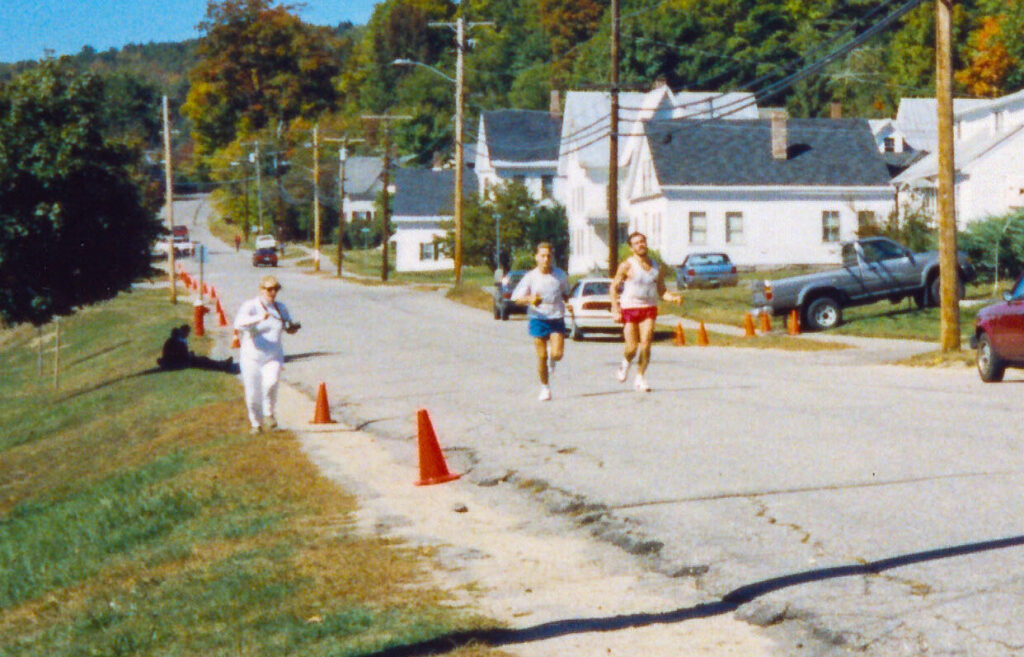
Me (in the red shorts) hanging on at the finish with (eight months!) pregnant Georgia running me in on the side.

Reality Steps In

Long story short, I managed to earn that BQ — but got injured during the race. With a newborn on the way and a Massachusetts winter to train through, I decided not to run Boston after all. Instead of racing from Hopkinton to Boston on April 15, 1996, we watched Uta Pippig’s triumphant win (and incredible grit) on TV.

Giving It Another Try

Fast forward to 2017: we’d moved to Florida, and I started entering a few local races again — 5Ks, a 10K, then my first half marathon in more than 20 years, and then another. Some went well, some didn’t, but the racing bug had bitten again.

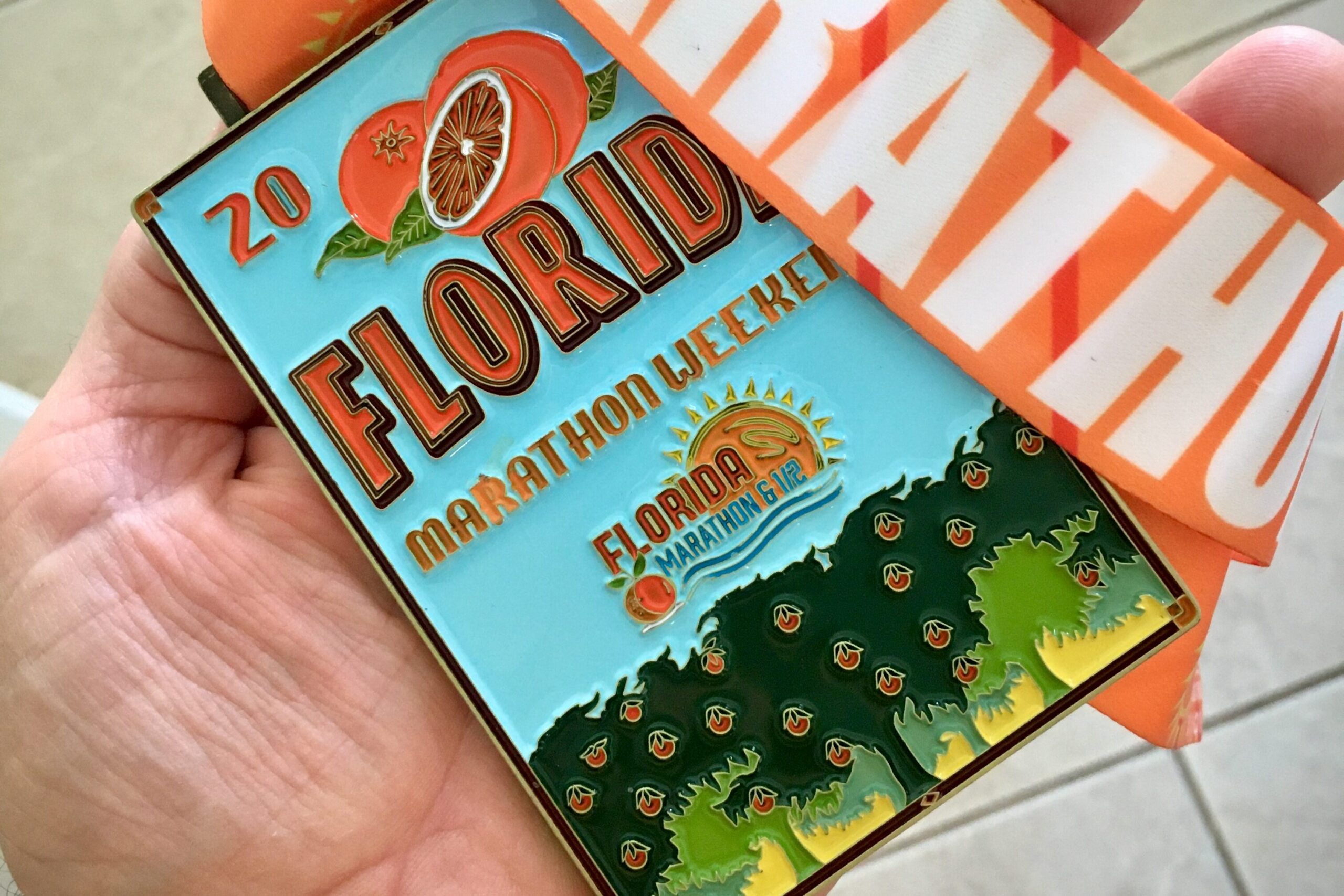
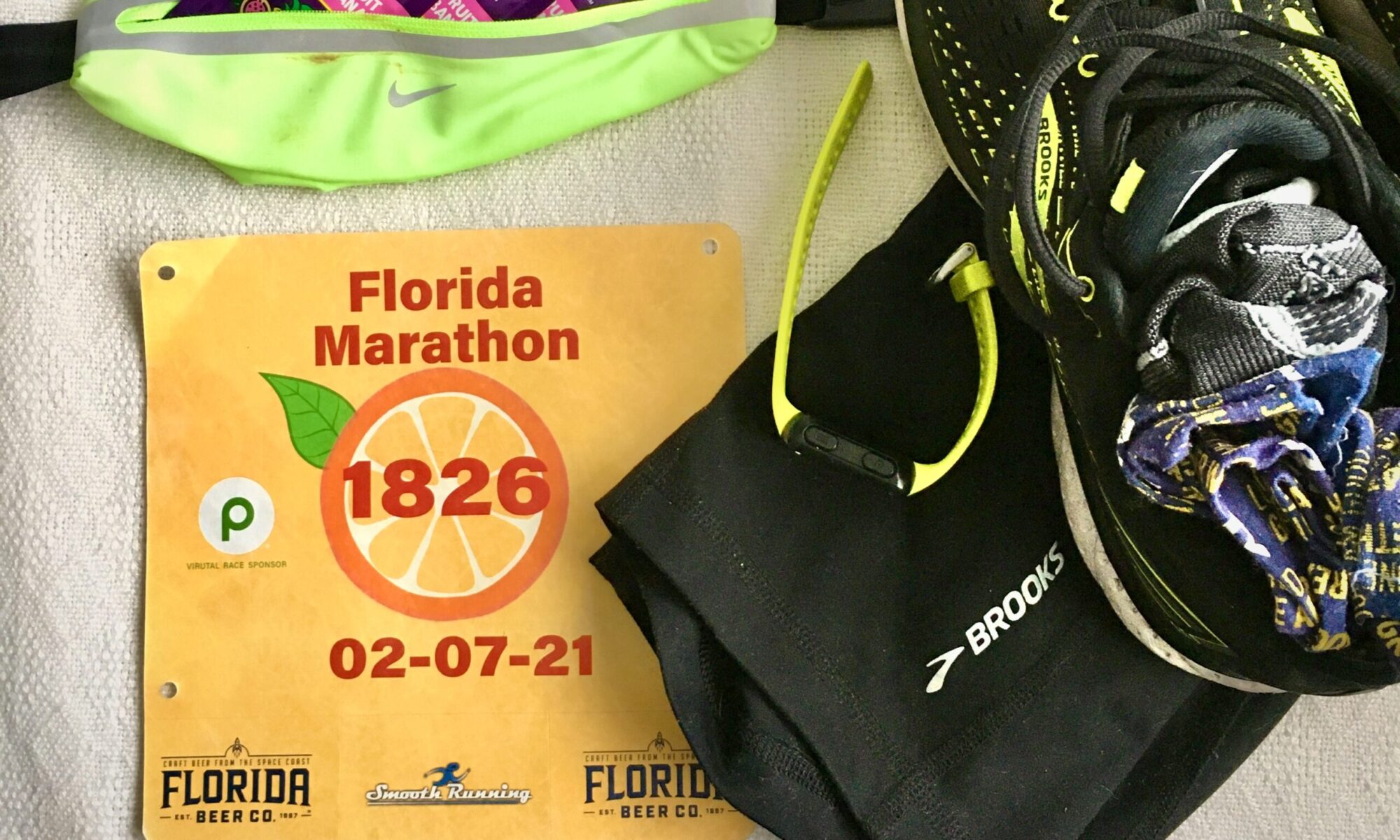
So I thought, Why not give the marathon another shot? I chose the 2021 Publix Florida Marathon on February 7, 2021. I had about four months to build mileage, add some tempo runs, and tackle a few bridges for “hill” training.

Race Day

Race morning arrived with a bang — literally. At our house, about 45 miles north of the course, lightning, thunder, and torrential rain woke us up. I was sure the race would be canceled. I texted our friend Paula, who replied, “Of course it’s on — it’s not raining in Melbourne.”

Sure enough, by the time we got there, it was just cloudy with a few sprinkles. Typical Florida weather.

But once the race started, the storm system moved steadily south. High winds, heavy rain, and severe thunderstorm warnings forced the Race Director to close the double-loop course after a small group of runners — myself included — had already started the second loop.

The Wheels Start to Fall Off

At first it wasn’t too bad, until mile 19, when I could see dark, lightning-streaked clouds rolling in from the top of one of the bridge crossings. Uh-oh. The rain returned, then strengthened, and the wind picked up.

Of course, I made all the rookie mistakes: went out too fast, didn’t drink enough, carried too few calories (three gels is not enough). I had hoped to average just under eight minutes per mile — enough to qualify for Boston in the 55–59 age group — but by mile 19, I was fading fast.

The Turnaround

By mile 21, the “I can’t keep going” voices had arrived. I was trying to accept that the BQ might be gone and just focus on finishing.

Then two women — experienced marathoners, Angela Treleven Persich and another runner she’d met that day — cruised up beside me, running smooth and steady. They were right on the pace I needed, so I asked if I could hang with them.

They chatted, encouraged me, and kept their rhythm even as rain pelted us and the course flooded in ankle-deep water. I hung on all the way to the final mile and the last bridge climb — into the wind, through driving rain — and down to the finish line. For real, I left it all on the course.

At the end, it was pouring, the wind howling. Georgia was there at the final stretch, cheering (after running her own 5K earlier). I crossed the line in 3:27:23 about seven minutes under the qualifying mark of 3:35:00. Woot!

It was an unforgettable day — and a reminder that even solo sports aren’t always solo.
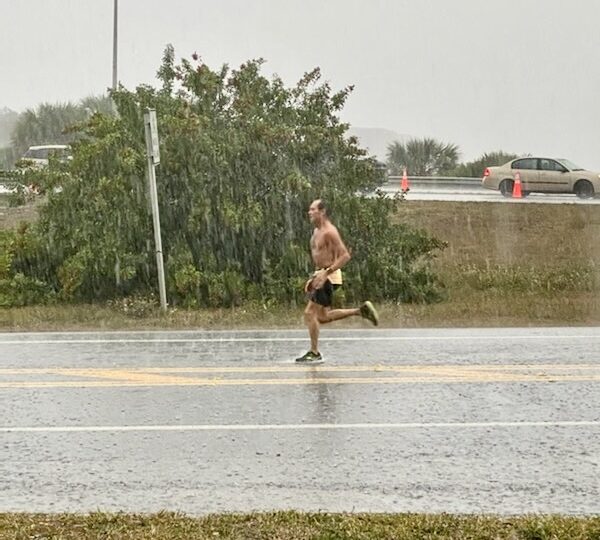
Finally headed for the finish line in the pouring rain!

The Takeaway

A few days later, Angela messaged me:

“Running is a team sport, not individual! My life has been so enriched running races and meeting people along the journey.”

She was right. This race wasn’t just about time, or even finishing — it was about rediscovering the power of community, endurance, and shared effort.


If you liked this post, please let us know by leaving a comment below and consider supporting the site.

Getting From the Start to the Finish Line Makes You Special. Go You!

It’s like cake! Let me explain…


I’ve been a runner for decades.

In those decades, I have participated in races of all kinds and distances—giant events to local fun runs. At those races have been real runners of ALL ability levels, and I get excited that people have shown up and are ready to go for it.

Like many of us, I have had times when I have trained for specific events and periods when I’m just trying to keep moving regularly. I’ve also spent time as a Certified Personal Trainer and coaching friends with their running. So, I have had many opportunities to encourage beginners and other runners who feel intimidated or discouraged about their abilities compared to “real runners.”

The Conversation

Here is a conversation I have had many times with other runners, particularly recreational runners or new runners, but also long-time participants.

It goes something like this:

me: “Hey, good to see you here at the race! You ready to go?”

them: “Hi! Well, I’m okay, but I’m not as fast as most of these people…”

me: “That’s no big deal, everyone is at a different stage in their fitness and experience. You got here — you do your thing.”

them: “I haven’t done too many races, so…I’ll probably need to walk a little.”

me: “and that’s perfectly fine. After all, you’ll still be beating every single person who couldn’t get off the couch this morning!”

So What’s The Cake Part?

The point I want to make to people when we have this conversation is that they are already way ahead of lots of others and are actually pretty special.

That’s when I say that it’s like cake.

Imagine a nice frosted layer cake representing the entire population. Everybody.

Continuing with the metaphor, the frosting on the top is everyone who does some running or jogging (15% of the US population).

Any distance at all. Any speed.

Then, the very top part of the frosting (the part with the sprinkles or the decorative ganache) are people who enter and run in a road race. Everyone from Faith Kipyegon and Eliud Kipchoge to your 85-year-old grandma who walks a 5K in an hour and a half.

Everyone.


According to this IAAF report, about 0.1% of the US population races. The world’s highest is Ireland at 0.5%

Also, worldwide, about 1/3 of the population aged 15 and over doesn’t get enough basic exercise, and this study identifies many troubling consequences.


Showing Up Makes You Special

Even though there are a few thousand runners at many events, they are still this teeny tiny percentage of the general population.

Therefore, simply showing up and running the race puts you in the highest percentile of not only the population, but also active runners.

So, “yay us!” I say.

Keep moving, keep running, and I’ll see you at the next race. Let’s all be frosting together.


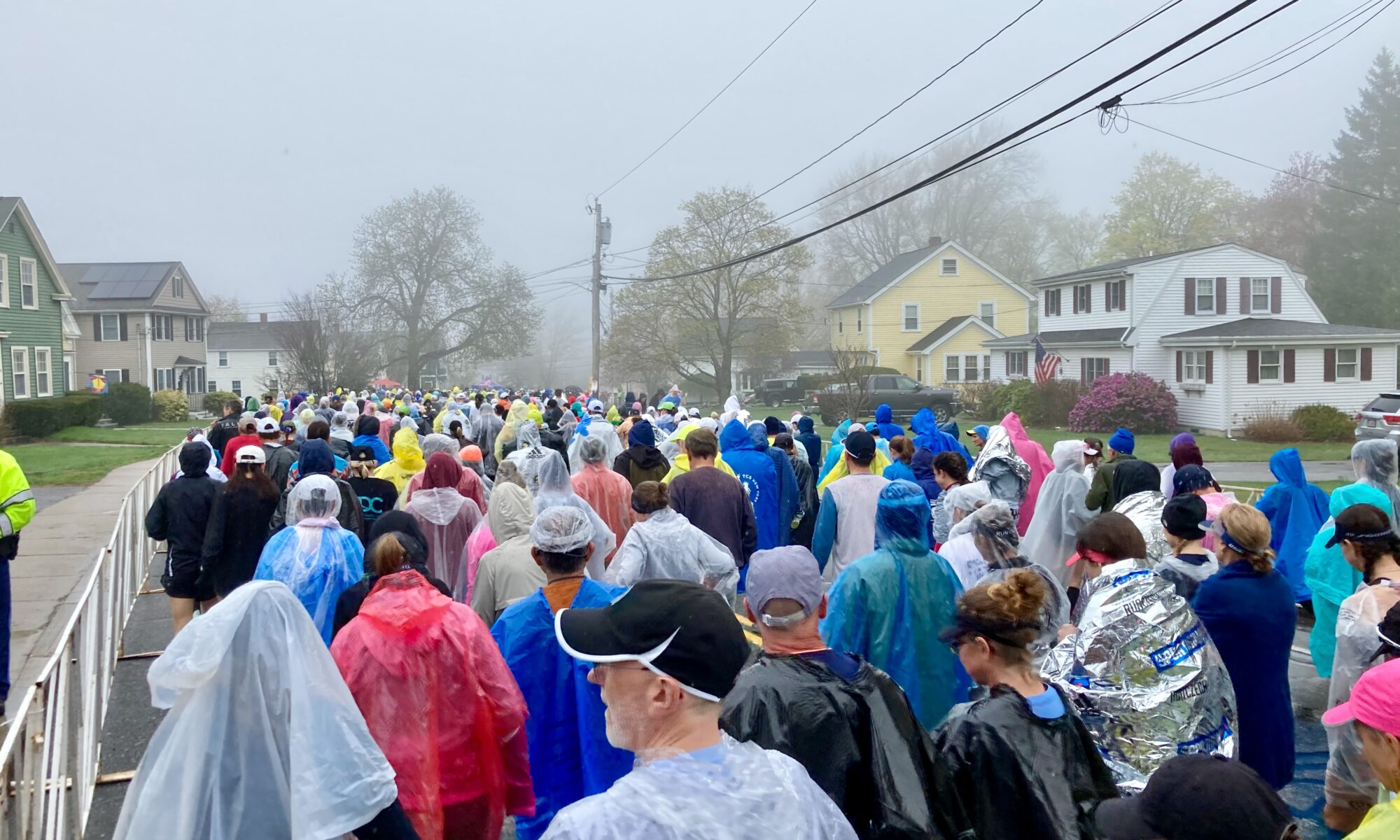
photo: The start corral crowd of runners at the 2023 Boston Marathon (by the author)

If you liked this post, please let us know by leaving a comment below and consider supporting the site.

You’re Never Too Old to Be a Real Runner

Running is something natural, right?

You did it as a kid without thinking. You just took off across the yard, chased your friends, ran for the sheer joy of it. It was effortless—and honestly, it was pretty fun.

Then life happened. Work, family, responsibilities, decades of being “busy.” Maybe a few aches showed up. Maybe the idea of exercise became something serious instead of something joyful. But eventually you decide: I’m going to start running again. And it seems simple, right? Lace up, head out the door, take off down the street or onto a trail.

Is This Real?

Except… maybe now it’s a little slower. Maybe you’re not exactly gliding. Maybe you need to—gasp—alternate walking with running. And then some other runner comes cruising by, smooth and fast, and you think, “Now that’s a real runner. That’s what I’m working toward.”

Sometimes that’s motivating. Sometimes, for newer or older runners, it’s discouraging: I’m never going to run like that again. Or maybe you’re mid–walking break and feel a little embarrassed.

Going For It

But you keep at it. You get stronger. You take fewer walk breaks. You start noticing the fancy shoes with the giant foam stacks and the watches that look like mission control. You hear people talk about marathons, BQs, age-group records, and those Abbott World Marathon Majors stars.

And then somebody convinces you to join Strava, where normal-looking humans are apparently out there running 40-mile weeks and crushing monster workouts before breakfast.

Here’s the truth: you don’t need any of that. That isn’t what defines you as a “runner.”

Not the races, not the watches, not the super shoes, not the selfies, not the social media uploads, not the mile splits, not the comparison game. You don’t even need to run the whole time.

At our age, (and, really, any age) the magic is wonderfully simple. There’s only one thing you need to do to be a real runner:

Get on your feet and start running.

Your pace doesn’t matter. Your walk breaks don’t matter. Your age absolutely doesn’t matter. If you’re out there moving forward—consistently, joyfully, at whatever speed works for your body—you’re already a real runner.

Oh, and don’t forget the most important part:

Have fun doing it!


If you liked this post, please let us know by leaving a comment below and consider supporting the site.